 Shiba inu
 transaction checks show when to stop, adjust, wait, retry, or reconcile
A SHIB transaction is ready only when its network, token contract, transaction target, recipient or spender, any required permission, and gas asset all match the intended action. Before signing, compare those fields with the wallet prompt and keep the option to close it without changing on-chain state. After signing, use the transaction hash on the matching network to distinguish a pending record from a failed or successful receipt. That evidence determines whether to wait, correct an input and retry, reconcile a balance display, or stop. A ticker and wallet balance cannot resolve a network mismatch by themselves, while a receipt can show whether the network executed the signed request.
Updated onReadiness begins with the network and transaction target
A SHIB request is ready for review when the wallet is connected to the intended network and displays the expected account, contract target, action, and fee asset. Ethereum and Shibarium keep separate transaction histories even when a wallet shows the same account address on both. The receiving service must also support the selected network. A valid address alone does not establish that support.
Ethereum transactions require ETH for gas, including transactions that move an ERC-20 token. Shibarium mainnet uses BONE as its native gas asset. The SHIB balance and gas balance therefore answer different questions. Holding enough SHIB for a transfer or swap does not establish that the account can pay for execution on the chosen network.
The transaction target changes with the action. A direct transfer calls the token contract with the recipient and amount as arguments. An approval names a spender and an allowance, while a swap request targets a contract that applies its encoded exchange conditions. An unsigned preview is the reversible first step: inspect its network, target, amount, permission, and fee estimate, then close it if any field conflicts with the intended action.
Transaction states separate intent from execution
Transaction terms identify how far a request has progressed and prevent a draft, signature, broadcast, and receipt from being treated as equivalent evidence. An unsigned draft has not authorized an on-chain change. A signature authorizes a specific payload, but signing alone does not prove that a network received it. A transaction hash identifies the signed request, and its appearance on the matching network shows that the request reached an observable transaction state.
A pending record has no included receipt yet. Once the network includes the transaction in a block, its receipt records the block reference, execution status, gas use, and emitted logs. A failed receipt means the network executed the request and reverted the call's state changes, while still consuming gas. A successful receipt confirms top-level execution, although the logs and resulting balances must still match the intended SHIB action.
SHIB is an ERC-20 token on Ethereum. ERC-20 transfers emit a Transfer event, and approvals establish an allowance for a named spender. These events describe different outcomes. A successful approval can remain active even if a later swap fails because the approval and swap may be separate transactions.
What does the first observable state tell you to do?
The strongest available evidence determines the next action: stop at a visible mismatch, adjust a rejected request, wait for an included receipt, retry only after correcting a failure, or reconcile a successful result.
| Observed evidence | Next decision | Information required first |
|---|---|---|
| An unsigned prompt shows a network, contract, destination, or spender mismatch | Stop and discard the request | The intended network, token contract, recipient, and authorized action |
| Preflight or submission is rejected, and no transaction hash appears | Adjust the input, then build a fresh request | The exact error, available gas asset, and unchanged destination details |
| A hash exists, but the matching network has no receipt yet | Wait and monitor without sending a duplicate | The correct network, sender address, transaction hash, and nonce |
| The receipt reports failed execution | Correct the identified cause before retrying | The receipt details, any decoded revert reason, and remaining gas balance |
| The receipt reports success and contains the relevant event | Reconcile the resulting balance or service display | The intended contract, recipient or spender, amount, and expected state change |
These states do not supply a universal waiting time. They establish whether the request remains reversible, occupies a nonce, has consumed gas, or has already changed on-chain state. The shared criterion is observable execution evidence, not the age of a wallet notification. A fresh signature becomes appropriate only after the earlier state is understood.
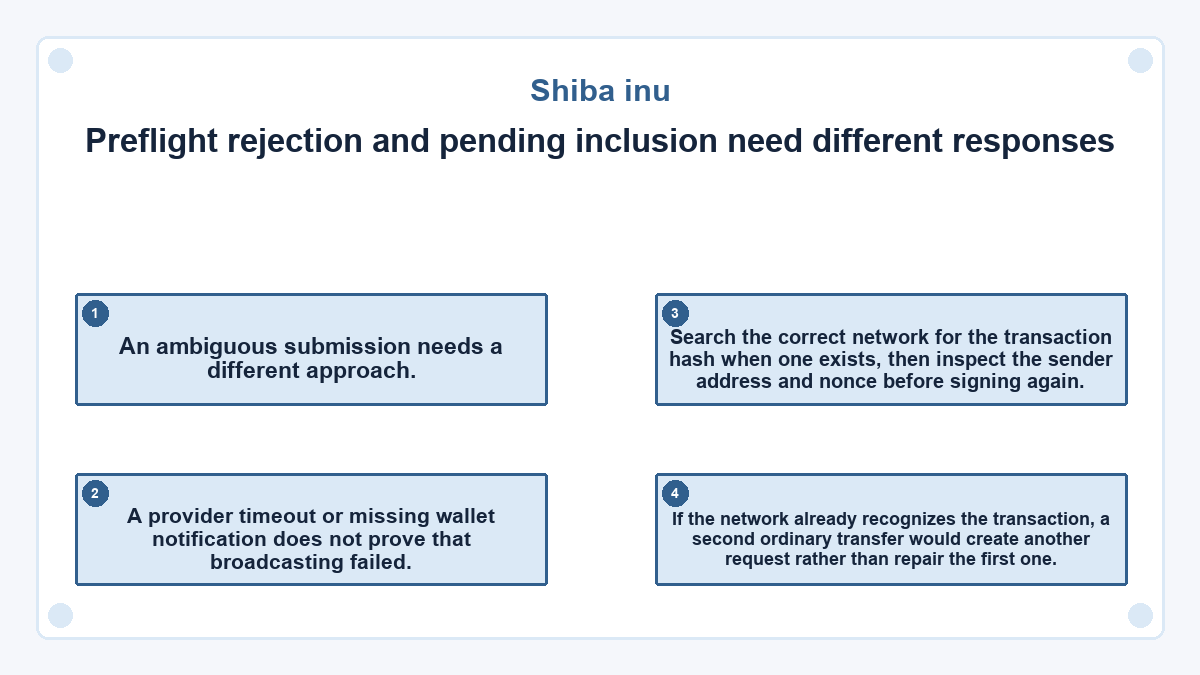
Preflight rejection and pending inclusion need different responses
A preflight rejection occurs before confirmed inclusion and often points to a condition that can be changed without duplicating an on-chain action. Insufficient native gas, a rejected estimate, an expired transaction condition, or a contract simulation failure can block submission. Record the exact message and recheck the proposed call. A successful estimate is useful, but it cannot guarantee inclusion or successful execution because fee conditions and contract state may change before inclusion.
An ambiguous submission needs a different approach. A provider timeout or missing wallet notification does not prove that broadcasting failed. Search the correct network for the transaction hash when one exists, then inspect the sender address and nonce before signing again. If the network already recognizes the transaction, a second ordinary transfer would create another request rather than repair the first one.
A pending EVM transaction occupies its nonce until it is included, dropped, or replaced. A replacement normally uses the same nonce and a sufficiently higher fee, but the wallet must support that operation. Resolve the oldest pending nonce first when later transactions cannot advance. Waiting is appropriate while the original request remains valid and observable; replacement makes sense only when its unchanged call data still reflects the intended action.
Successful execution must match the intended SHIB effect
A successful receipt proves that the top-level call completed without reverting, but the expected effect depends on the method that ran. For a direct SHIB transfer, inspect the token contract and Transfer event for the sender, recipient, and amount. The transaction's top-level target is the token contract, so that field alone does not identify the receiving wallet.
An approval has a different completion test. Its successful receipt and Approval event establish the spender and allowance; they do not show that a swap occurred. Before continuing, compare the live allowance with the next contract request. A route that changes the spender needs a separate permission decision, even if another allowance already exists.
Contract-based exchanges can emit several token movements during one successful call. Match the received asset and final balance change with the signed conditions instead of treating every Transfer event as the desired output. A quote shown before signing is planning information, while the receipt and resulting contract state record what executed.
Custodial destinations add an off-chain reconciliation step. An on-chain success does not prove that a service has credited its internal account, particularly when that service does not support the network used. Preserve the hash and receipt, confirm the supported deposit route, and avoid resubmitting a completed transfer merely because the service balance has not changed.
A new signature begins only after the old state is resolved
The stop boundary sits before any signature whose network, contract, recipient, spender, or encoded action remains uncertain. Closing an unsigned prompt preserves the current on-chain state. Signing another request is not a neutral refresh: it can create a separate transaction, establish a new allowance, or compete for an occupied nonce.
For a rejected request, change only the field tied to the identified error and review the rebuilt payload from the beginning. For a failed receipt, account for the gas already consumed and correct the execution cause. For a pending record, wait or use a deliberate same-nonce replacement. For a successful receipt, reconcile the intended event and balance rather than submitting the action again.
Keep the transaction hash, network, sender, nonce, receipt, and relevant token event together until the result is settled. Those records distinguish a display problem from an execution problem and preserve a clear exit point. On Ethereum, that boundary appears before the SHIB contract call becomes a signed transaction.
Good to know
Is a wallet gas estimate a guaranteed final fee?
No, a gas estimate is a preflight calculation based on the proposed call and the state available when the wallet evaluates it. Actual gas use depends on execution, while the fee per gas depends on inclusion conditions and the signed fee limits. The fee is based on the gas used rather than the full gas limit, but a reverted transaction still consumes gas before it fails.
Does changing the gas fee alter the SHIB instruction?
Changing only the fee settings should leave the intended SHIB call unchanged, but the replacement is still a new signed transaction that needs review. Confirm the network, nonce, contract target, recipient or spender, amount, and call data before authorizing it. A valid same-nonce replacement competes with the pending request; a transaction with another nonce does not replace the earlier one.
Can an RPC timeout mean the SHIB transaction was broadcast?
Yes, a timeout can leave the broadcast result uncertain rather than proving that submission failed. If the wallet produced a hash, search for it on the selected network. Otherwise, inspect the sending address, recent nonces, and wallet activity before signing another request. This separates an unbroadcast draft from a transaction that reached another node but was not acknowledged by the original provider.
Should I sign again when the wallet and explorer disagree?
Do not sign again until the disagreement has a specific explanation. Confirm that the wallet and explorer are using the same network, then compare the hash, sender, nonce, contract, and receipt. A successful receipt outweighs a stale wallet notification, while a missing explorer record may indicate the wrong network, delayed propagation, replacement, or failed broadcast. Resolve that state before creating another SHIB instruction.