 Shiba inu
 burn methods separate irreversible supply reduction from fee conversion and bridge accounting.
Shiba inu burn methods do not all change supply in the same way. A direct call to the SHIB token's burn function reduces total supply, while a transfer to a recognized inaccessible address leaves tokens at that address and changes circulation accounting. Shibarium fee burns add conversion and checkpoint steps before SHIB reaches its final destination. Compare the initiating wallet, fee asset, contract action, transfer event, and receipt before counting any amount as removed from circulation.
Updated onThe proof must match the claimed supply effect
Calling the SHIB contract's burn function destroys units from the caller's balance and reduces the contract's reported total supply. Sending SHIB to an established inaccessible address is an ordinary ERC-20 transfer. Those tokens remain in the address balance, although circulation trackers may subtract that balance when calculating post-burn supply.
A service can add approvals, swaps, checkpoints, or treasury actions before either outcome. Its dashboard may show progress, yet the decisive record remains the transaction executed by the relevant token contract. A successful approval proves that a spender received permission. A swap proves that assets changed. Neither record alone proves that SHIB was burned.
Six burn paths differ in proof and recovery
Methods can be compared on the same dimensions: the SHIB source, the final token action, and the point after which recovery is impossible. This prevents a conversion, deposit, or bridge operation from being mistaken for a completed supply burn.
| Burn path | Evidence of completion | Recovery boundary |
|---|---|---|
| SHIB token-contract burn |
A successful call to burn(uint256), a transfer event to the zero address, and a lower totalSupply()
|
The destroyed units cannot be restored after successful execution |
| Direct transfer to a recognized burn address | A successful SHIB transfer event showing the established inaccessible destination and amount | The transfer is irreversible if the destination has no usable private key |
| Allowance-mediated burn | The approval, contract call, and final SHIB burn or transfer event must form one traceable sequence | Unused allowance may be revocable before the contract spends it; the final burn is not reversible |
| Treasury or campaign batch | The treasury's final on-chain burn call or transfer, rather than a pledge or internal counter | The allocation can change before execution, but a confirmed final burn cannot be recalled |
| Shibarium base-fee burn through ShibTorch | Fee accumulation, conversion, checkpoint progress, and the completed SHIB burn transaction | A participant can stop before signing an initiation step; completed SHIB removal has no recovery path |
| Shibarium bridge withdrawal burn | The Shibarium burn and corresponding Ethereum unlock or release record | Recovery follows the bridge exit process because this burn changes network representation rather than net supply |
| Summary: the final event determines whether an amount reduced total supply, moved out of usable circulation, or only changed network representation. | ||
The same SHIB amount can therefore produce different accounting results. Read the transaction method and event logs instead of relying on the word “burn” in an interface. An interface label describes an intended action; the receipt shows what the network executed.
What changes when SHIB reaches a burn address?
A burn-address transfer moves SHIB from the sender to an address treated as inaccessible, so the sender's balance falls and the destination balance rises. The token contract's total supply does not fall from that transfer alone. The SHIB token contract also exposes a burn function that removes the caller's tokens from total supply and emits a transfer to the zero address. These outcomes need separate labels when totals are compared.
Direct transfers and mediated burns expose different permissions
A direct action sends one call to the SHIB contract without granting a separate spender allowance. A mediated path can introduce a spender, conversion contract, campaign treasury, or checkpoint process. Every additional component changes what must be checked before the final receipt can support a burn claim.
Direct contract action
The native burn function operates on SHIB held by the calling address. Raw contract interfaces may request the amount in the token's smallest units, so the decoded amount deserves attention before signing. The receipt should identify the established SHIB contract, show a successful status, and contain the expected transfer event. A failed call leaves the intended SHIB amount in the wallet.
Approval followed by execution
A burn service may first request an ERC-20 allowance. That approval names a spender and a maximum amount; it does not move or destroy SHIB by itself. The later contract call must spend the intended amount and end with a recognizable burn action. If execution never follows, review the remaining allowance separately because the permission can persist after the session closes.
Shibarium fees become SHIB only after conversion
Shibarium uses BONE as its gas asset, while the burn target is SHIB. Its base-fee path therefore accumulates BONE before conversion. ShibTorch exposes the staged process, including initiation and completion records. Activity on Shibarium contributes to the fee pool, but a transaction paying BONE gas is not itself a direct SHIB burn.
The amount ultimately removed depends on the eligible BONE balance, the platform fee shown for that burn, and the BONE-to-SHIB conversion. Those inputs can change, so a forecast should not be reported as a completed burn. Check the final SHIB transaction after the conversion and required checkpoint steps. The completed amount belongs to the receipt, not an earlier estimate displayed during accumulation.
Network fees change the sensible burn path
An Ethereum burn requires ETH for gas, whether the wallet calls the native burn function or transfers SHIB to an inaccessible address. The fee follows Ethereum execution conditions and transaction complexity; it is not calculated as a fixed percentage of the SHIB amount. This can make repeated small burns consume more gas than a single grouped action, although grouping also delays finality until the batch is submitted.
Shibarium transactions use BONE for gas. Its base-fee mechanism does not let a holder substitute an arbitrary personal SHIB balance for the accumulated fee pool. Compare costs in their native units, then keep the burn amount separate from the fee paid to execute or initiate the process. A cheap transaction is not stronger proof, and an expensive one does not remove more SHIB unless its token events show that result.
How can a burn be verified on-chain?
Verification begins with the transaction hash on the network where the action occurred. The receipt must succeed, and its decoded events must identify the established SHIB contract, sending address, destination or zero address, and exact token amount. A wallet notification or service counter cannot replace these fields.
Match the transaction to the intended mechanism
- Confirm that the hash exists on the stated network.
- Read the receipt status rather than the submission message.
- Match the SHIB token contract and the initiating address.
- Inspect the method call, destination, amount, and transfer events.
- Separate gas paid from SHIB removed or transferred.
Check the supply measure that should move
After a native burn call, compare the transaction amount with the change represented by the burn event and contract supply. After a dead-address transfer, verify the destination balance change and use a circulation measure that explicitly excludes recognized burn holdings. When a tracker combines both categories, its methodology and inclusion time can explain why its headline total differs from a single transaction.
Pending, failed, and successful receipts lead to different actions
A submitted transaction is only an intention until the network includes it. The transaction hash lets the sender distinguish waiting from correction without signing a duplicate blindly.
Pending submission
A pending burn has not produced final token evidence. Check the sender's nonce and the transaction's presence on the correct network. Replacing or canceling it is possible only while the account and network still permit a transaction with that nonce; wallet support and fee conditions affect whether the replacement is accepted.
Failed execution
A failed receipt means the requested contract state change did not complete. Inspect the called contract, balance, amount encoding, allowance, and execution error before preparing another attempt. Do not add the requested amount to a burn total merely because the wallet signed and broadcast the transaction.
Successful execution with an unexpected display
A successful receipt can coexist with a stale wallet balance or delayed tracker update. The token event and contract state take priority over a cached interface. If the event shows a different amount or destination from the intended burn, treat that as the executed result rather than adjusting the record to match the original plan.
Once the existing hash has a clear state, the next action becomes narrower: wait for inclusion, correct an input, reconcile a display, revoke an unused allowance, or stop. A second signature should begin a new attempt only after the first nonce and receipt are resolved.
Which burn claims belong in separate accounting?
Native supply destruction, dead-address holdings, automated fee burns, and bridge burns describe different ledger changes. They should not be added together without checking whether two records refer to the same SHIB or whether one action has a corresponding release elsewhere. A Shibarium withdrawal burns the mapped token on Shibarium and unlocks its counterpart on Ethereum, so the bridge operation keeps cross-network circulating supply unchanged.
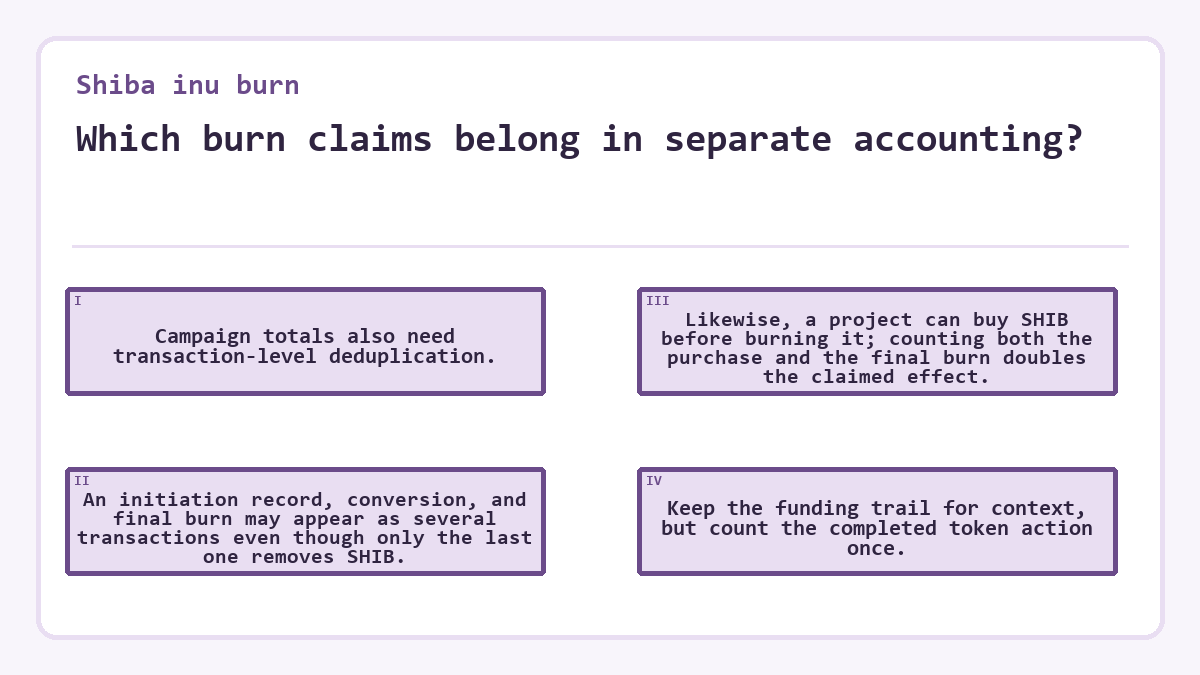
Campaign totals also need transaction-level deduplication. An initiation record, conversion, and final burn may appear as several transactions even though only the last one removes SHIB. Likewise, a project can buy SHIB before burning it; counting both the purchase and the final burn doubles the claimed effect. Keep the funding trail for context, but count the completed token action once.
Choose the proof before committing the amount
Select the method by the supply effect that needs to be demonstrated. Use the native burn record when total supply must fall, a recognized inaccessible destination when post-burn circulation is the measure, or the complete ShibTorch trail for fee-funded burns. Confirm the network, contract, amount format, gas asset, and expected event before signing. The next decision is the amount that can be made permanently unrecoverable with a receipt you can verify.
Shiba inu burn FAQ
-
Can a failed SHIB burn still cost gas?
- Yes. A failed Ethereum or Shibarium transaction can consume gas because validators still processed the attempted execution. The failed receipt means the requested SHIB state change did not complete, so the intended token amount should not be counted as burned. Review the failure, amount encoding, balance, allowance, and contract target before retrying. The replacement transaction requires its own gas and produces a separate receipt.
-
Does reducing the SHIB supply guarantee a higher token price?
- No. A burn changes a supply measure, but market price also reflects demand, liquidity, trading conditions, and holder behavior. A dead-address transfer may reduce usable circulation without changing the token contract's total supply, while the native burn function reduces total supply directly. Neither mechanism fixes demand or sets a future price. Evaluate a burn by its verified token effect rather than a projected market outcome.
-
Does a custodial SHIB balance reduction prove an on-chain burn?
- No. A reduced balance inside an exchange or custodial account can reflect an internal ledger entry, withdrawal, fee, or other account adjustment. Proof of a burn requires the custodian's completed on-chain transaction and the corresponding SHIB event. Until that record exists, the account change should not be included in an on-chain burn total. Custodial recovery options also depend on the service before the final transaction is executed.
-
Will a public SHIB burn reveal the sender's identity?
- A public burn reveals the sending address, transaction history, amount, timing, fee, and related contract events. It does not automatically reveal the person's legal identity. However, an address can become associated with someone through exchange records, prior disclosures, reused addresses, or linked transactions. Anyone publishing a burn hash should assume that observers can analyze the wallet's wider activity, not only the burn itself.